
A practical approach to litter beetle management in poultry houses
The lesser mealworm, commonly known as the darkling beetle (Alphitobius diaperinus), is one of the important insect pests encountered in commercial poultry production. Both broiler and layer operations can experience infestations, making effective litter beetle management an important part of maintaining good poultry-house hygiene and biosecurity.

Understanding the litter beetle
The darkling beetle has four developmental stages: egg, larva, pupa and adult. Both larvae and adults can be found in poultry litter. One of the challenges in managing this pest is its ability to move beyond the litter into structural hiding places. Larvae can migrate into cracks, wall-floor junctions, insulation and other protected areas to pupate. These refuges can contribute to continued infestations and reinfestation between production cycles.
Beetle populations are often concentrated around feed spills, drinker lines, feeders, perimeter areas and locations where litter remains warm and moist. Effective management must therefore address both the visible beetle population and the environmental conditions that allow it to survive and reproduce.
Integrated Pest Management: the foundation of effective control
An Integrated Pest Management (IPM) approach provides a more sustainable framework for managing litter beetles. Rather than relying exclusively on insecticide applications, an effective program should incorporate four key elements:
1. Sanitation and litter management
Between production cycles, spent litter and manure should be removed according to the farm's established biosecurity procedures. Particular attention should be given to feed residues, accumulated organic material, floor edges and areas beneath equipment.
Good litter management is equally important during production. Wet or caked litter should be addressed promptly, leaking drinkers repaired and unnecessary feed spillage minimized.
2. Structural management
Poultry-house structures can provide important refuges for litter beetles. Wall-floor junctions, cracks, door thresholds, feeder and drinker supports, damaged insulation and other structural defects should be inspected regularly. Where possible, suitable cracks and damaged structural areas should be repaired during downtime to reduce available hiding and breeding sites.
3. Targeted insecticide treatment
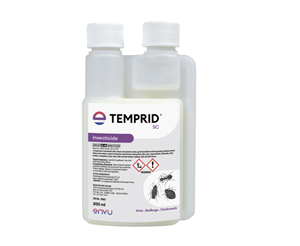
Chemical control can form an important part of an IPM program when products are applied according to their registered uses and approved label directions. Temprid® SC from Envu is registered in South Africa for litter beetle (lesser mealworm) control and provides a label-directed litter treatment option.
The South African label specifies the following dilution rates:
|
Infestation category |
Temprid® SC dilution |
Spray volume |
|
Normal infestation |
20 ml per 10 L water |
50 ml spray mixture/m² |
|
High infestation |
40 ml per 10 L water |
50 ml spray mixture/m² |
The prepared spray mixture is applied at 50 ml/m² over the litter after it has been placed in a cleaned and disinfected poultry house. The treatment is then raked into the litter as directed by the product label. Correct application and coverage are essential. The treatment should be planned as part of the pre-placement preparation process, following the approved label sequence.
Important application limitation: These directions describe treatment of litter after placement in a cleaned and disinfected house. They do not authorize spraying birds or applying Temprid® SC in occupied poultry houses. Any proposed application during the production cycle must be specifically authorized by the current South African product label and confirmed with Envu Regulatory.
4. Monitoring and evaluation
Regular monitoring helps identify increasing beetle populations before they become more difficult to manage. Poultry producers and pest management professionals should establish fixed inspection points around the house, including perimeter litter areas, beneath feeders, around drinker lines, wall-floor junctions and known cracks.
Adult and larval activity should be recorded separately. Using consistent monitoring locations and methods makes it easier to identify population trends and evaluate the effectiveness of control measures.
Managing beetles throughout the production cycle
Litter beetle management should not be viewed as a once-off treatment. A structured program should cover the entire production cycle:
Before chick placement
Remove old litter and manure, clean and disinfect the house, inspect structural refuges, place fresh litter and carry out the label-directed Temprid® SC treatment.
During production
Focus on monitoring, feed-spill reduction, drinker maintenance, litter condition and structural inspections. Any additional chemical intervention must be selected from products and uses registered for the specific situation.
At the end of the cycle
Record beetle activity, identify hotspots, remove litter and manure in a controlled manner, and inspect the building for structural defects before preparing for the next flock.
This approach helps reduce the potential for beetles to carry over from one production cycle to the next.
Resistance management: think beyond insecticides
Resistance management is another important consideration in long-term litter beetle control. Temprid® SC contains two active ingredients: imidacloprid (IRAC Group 4A) and beta-cyfluthrin (IRAC Group 3A). Although the product combines two modes of action, this does not eliminate the risk of resistance development.
Repeated reliance on the same insecticide modes of action should be avoided. Good sanitation, litter management, structural maintenance and monitoring must remain central to the program. Where insecticide rotation is considered, only products registered for litter beetle control in the relevant poultry-house situation should be used, following their approved labels and an appropriate resistance-management strategy.
Building a more sustainable approach
Effective litter beetle management requires cooperation between poultry producers, pest management professionals and technical advisers.
By combining good hygiene, environmental management, correctly timed and label-compliant insecticide applications, and consistent monitoring, poultry operations can implement a more structured approach to managing Alphitobius diaperinus.
Successful litter beetle management starts with prevention, is supported by targeted treatment, and depends on continuous monitoring.
For the pest management industry, this represents an opportunity to move beyond reactive insecticide applications towards more comprehensive, integrated pest management programs that deliver long-term value to poultry customers.
Technical note: Always consult the latest approved South African Temprid® SC product label before application. This article does not replace product label directions, regulatory advice, farm biosecurity procedures or veterinary guidance.